Personal gates
This week I filed a trademark application for a company I can’t tell you the name of yet.
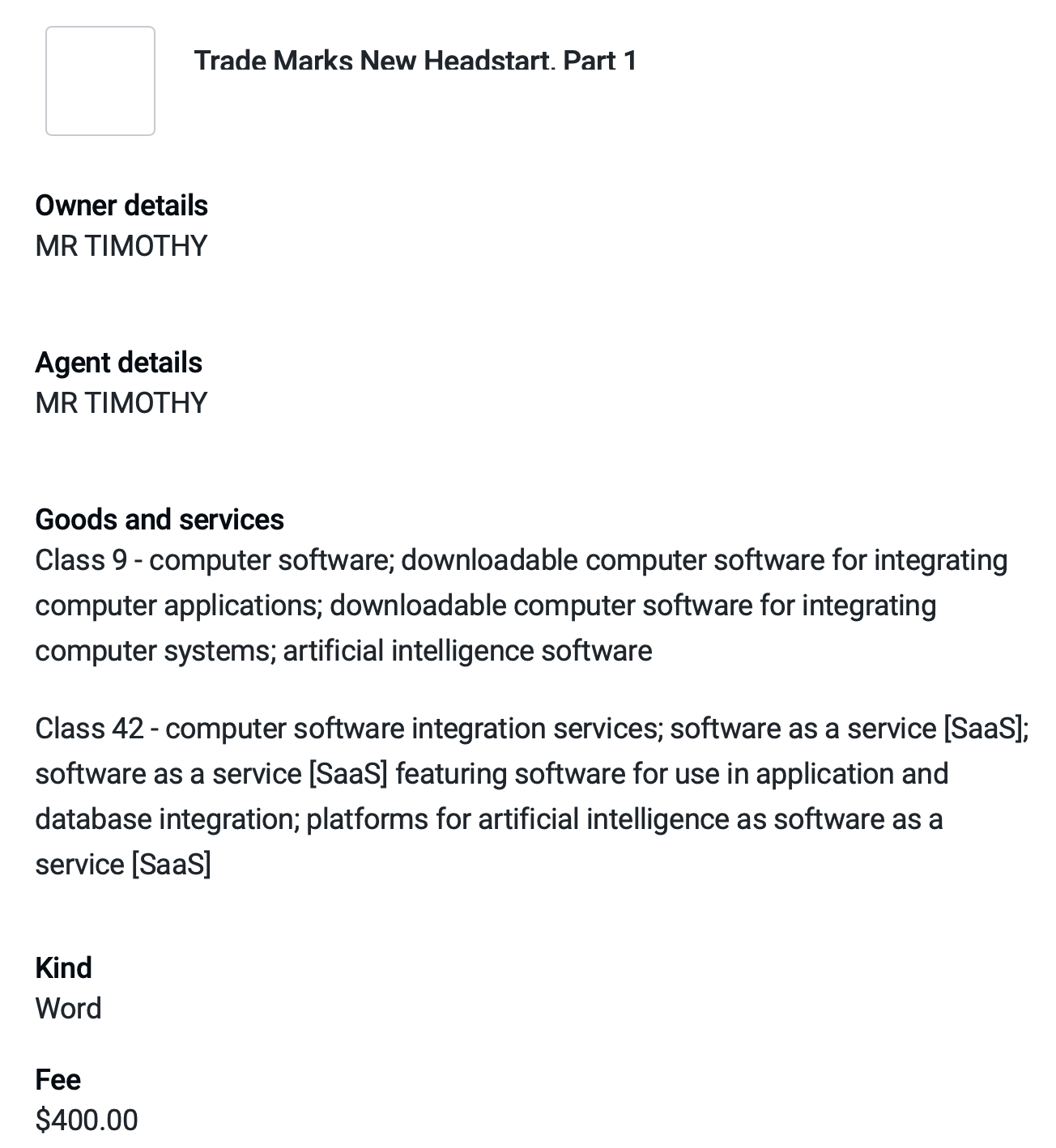
That screenshot is about as much as I can show for now. The word is the bit I’m not showing you; it gets a proper introduction in August. The name can wait. The week it capped off can’t, because it was one of the stranger weeks of my working life and I want to write it down while it’s fresh.
Last Friday was my last day of employment. I wrote about the handover - the agent-to-agent part still makes me smile. This week was the first Monday-to-Friday of whatever comes next: no payroll, no title, a home office, and a business that is now the only thing between my family and the mortgage.
Here’s what week one actually looked like.
The velocity
The part I can’t adequately convey with adjectives, so here are numbers instead. Everything here is built with Claude Code, and so far my usage would have cost ~$5,000 AUD at API rates. I was paying ~$150 AUD a month for it on a subscription, right up until this week when I kept running out of tokens and hitting usage limits and upgraded to the ~$300 AUD tier. At one point a single five-hour window of agent work would have billed ~$240 AUD on its own. That’s not a typo and it’s not a flex - it’s the new economics of building software, and I’m still recalibrating around it.
What did all those tokens buy? In four days:
- A command-line transcription tool became a deployed web app - upload a recording, get a speaker-labelled transcript, rename the speakers from snippet cues. Live on a domain with a real certificate by dinnertime.
- A shared core library got extracted from a fleet of services that had each grown their own copy of the same code. Eight modules, 169 tests, first consumer migrated and deployed.
- The “software factory” - my pipeline where agents build features on isolated branches, open pull requests, get adversarially reviewed by other agents, and only merge green - ran real batches and caught real problems, including one build that looked finished and was wired to nothing. The reviewer vetoed it. Machines catching machines.
- An end-of-financial-year reconciliation that would normally eat a weekend took an evening.
- Infrastructure got consolidated onto a new box because the old one was wheezing, certificates and DNS and all.
A year ago that list is a quarter. Last week it was four days, mostly while I was in meetings.
Worth naming how fast the delivery stack itself has moved, because it snuck up on me. Six months ago it was me and a chat window. Then a thinking partner with memory and skills. Then agents I could hand whole features to. Now the factory above - agents building, agents reviewing agents, gates on every merge. Each step felt incremental; the distance between the ends doesn’t. My job has quietly shifted from writing code to designing the gates the code has to pass through.
The body keeps its own ledger
Between the last day of employment and the first day of self-employment, I competed at a BJJ tournament. Pushed up into a bow-and-arrow attempt, couldn’t finish it, transitioned to a back take, ran out of time. Somewhere in the middle of that I bruised a rib properly - the diagnosis came back as three to four weeks off the mat.
Lately I’ve been training at least 5 sessions a week.. the mat is where a lot of my thinking settles, and it’s gone for a month - in the exact month the work went vertical.
I’d like to say I noticed that collision myself. I didn’t.
The part that matters
At the start of the year I published nine principles for 2026 - a framework to filter decisions through, grouped into mindset, building and foundation. What I didn’t say then is that they didn’t stay a blog post. They’re wired into Arc, the thinking partner I’ve been building all year. Alongside the skills that build software, Arc has two that build nothing: a pattern scan that reads my journal and shows me where attention actually went, and a principles check that scores a week against those nine.
I ran both over week one. The scorecard was blunt:
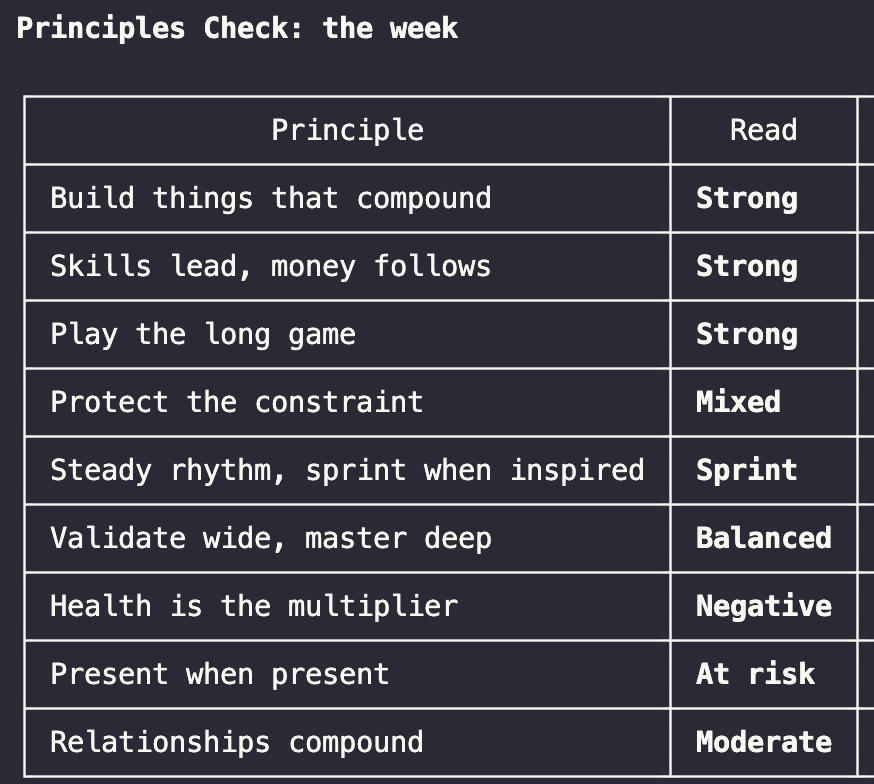
The top third is flattering - everything on the business side rated strong. It’s the foundation rows that sting: negative on health, at risk on presence. Behind those two words sit journal entries timestamped 2:30am, an injury removing the training rhythm at exactly the wrong moment, and every deferred item in the queue clustering around the same category - people. The thank-yous, the catch-ups, the follow-ups. The machine work jumped every queue; the human work stacked up in reminders.
It also caught something sharper. All my end-of-financial-year compliance got done on time, because 30 June is a deadline someone else enforces. My own invoicing - the money coming in - slipped badly, because nobody enforces it but me. Deadline-backed admin happens. Deadline-free admin defers. That’s not a discipline problem, it’s a structural one, so the fix isn’t a resolution - it’s automation with a human approval step, and it went into the backlog the same night.
This is the bit I actually want to land, more than the token numbers. AI has made building fast. Genuinely, disorientingly fast - the kind of fast where a week produces a quarter’s output and feels normal by Wednesday. Nobody talks about what that speed does to the person holding it. When the cost of building drops towards zero, the scarce thing isn’t output any more. It’s judgement about which output matters, and honesty about what the pace is costing you.
You don’t get that from the same enthusiasm that’s doing the building. You get it from gates. Mine happen to be built into the same agent that does the building, which is either elegant or ironic depending on your mood. Either way, the agent that shipped five things this week is the same one that told me to go to bed, watch my sleep, and put the humans back at the front of the queue.
The machine sets the pace. The gates are still mine to set.